
“Teeth in a day” is one of the most oversold phrases in dentistry, and also a real thing that happens every week in practices that plan carefully. The gap between those two statements is what this post is about.
What Does Same-Day Dental Implant Actually Mean?
It means the implant is placed and a temporary tooth is attached the same day, so you never walk around with a visible gap. The permanent restoration still comes later, after the bone fuses to the implant.
Same-day refers to immediate loading, not immediate completion. Our All-on-4 page describes exactly that sequence for full-arch cases: four implants are placed at precise angles, a temporary fixed denture is attached the same day, integration happens over a few months, and the permanent prosthesis follows.
Same-Day Versus Staged Treatment
| Same-day (immediate loading) | Staged treatment | |
|---|---|---|
| Day of surgery | Implant placed, temporary tooth attached | Implant placed, site closed to heal |
| Appearance in the interim | A fixed temporary from day one | A removable or gum-borne temporary |
| Bone requirement | Needs strong primary stability at placement | More forgiving of softer or thinner bone |
| Diet in the first weeks | Strict soft diet to protect the implant | Soft diet, but less force on the implant either way |
| Final restoration | After integration, months later | After integration, months later |
Neither column is the better option in the abstract. One is faster to a smile, the other is more forgiving of imperfect bone, and imaging decides which one your case belongs in. It is also worth noting that the two paths converge: the final restoration arrives on the same biological schedule either way, because osseointegration takes as long as it takes.
Who Qualifies for Same-Day Implants?
Immediate loading works when the implant is stable enough at placement to tolerate force right away, and when nothing in your biology is working against healing. In practice that means several conditions have to line up at once.
Enough Bone, in the Right Place
An implant that engages dense bone across its length has what surgeons call primary stability. Without it, an immediate temporary can micro-move the implant during the exact weeks bone is trying to attach. This is the single most common reason a case gets staged instead.
Healthy Gums
Active gum disease is a contraindication for loading an implant immediately, because inflammation and bone loss are already in progress at the site. Treating it first is not a delay tactic; it is what makes the implant survivable.
No Active Infection at the Site
An abscessed tooth being removed and replaced in one visit sometimes works, and sometimes needs the socket to heal first. That is a judgement call made with imaging and a look at the socket walls after extraction, not a decision that can be promised in advance.
Health and Habits That Support Healing
Smoking and uncontrolled diabetes both slow healing and raise failure rates, and heavy grinding puts overnight force on an implant that has not yet integrated. None of these automatically rules you out, but each one shifts the balance toward the staged approach.
Who Should Wait?
- Patients whose imaging shows thin or soft bone at the site
- Anyone with untreated periodontal disease
- Sites with active infection where the socket needs to heal first
- Heavy grinders without a nightguard plan
- Patients who need bone grafting before an implant can be placed at all
Waiting does not mean going without teeth. A temporary that rests on the gum rather than on the implant covers the interim, and it is the standard trade for protecting the implant during integration.
How Does the Practice Decide?
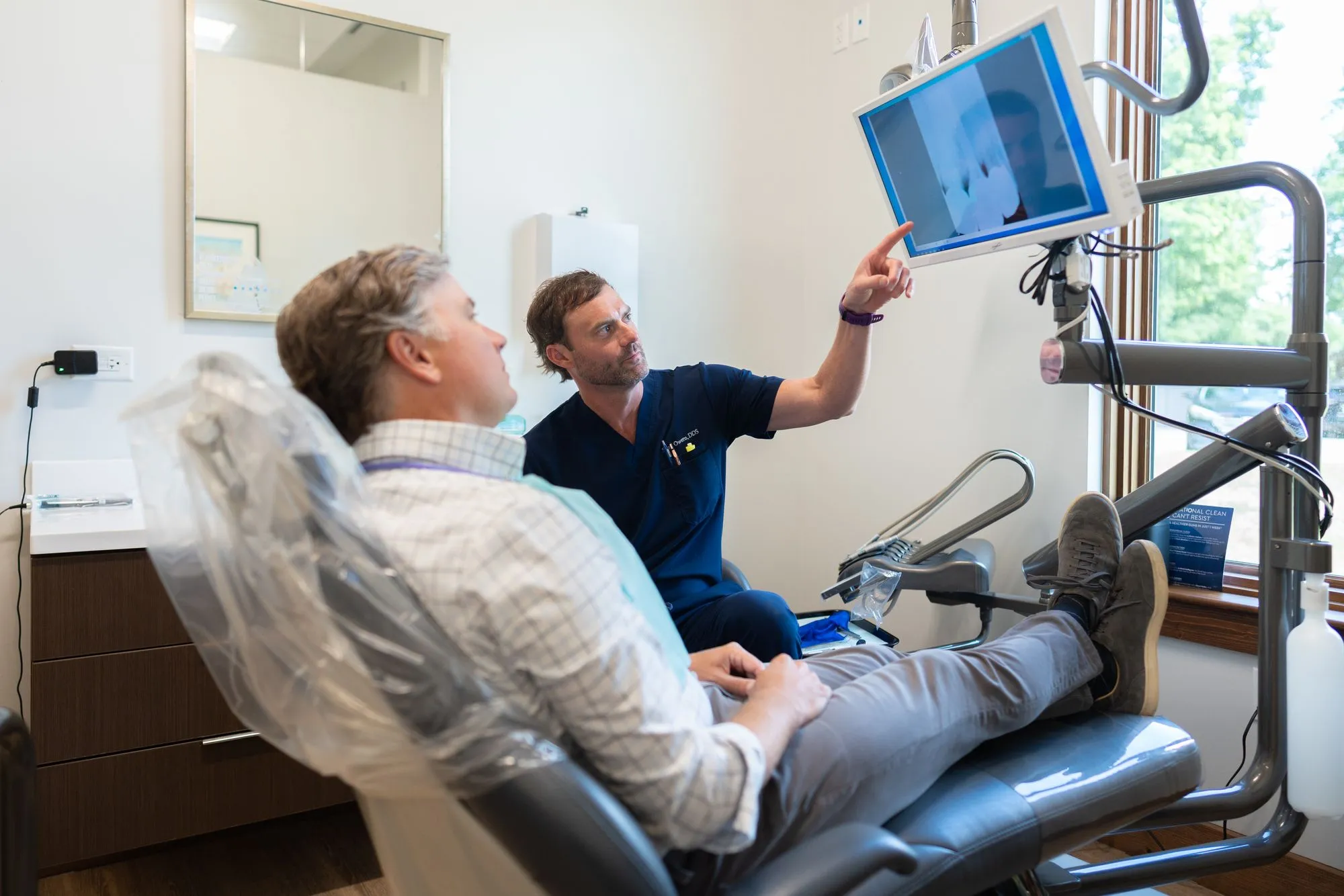
The decision comes out of a consultation with digital imaging and 3D scanning rather than a phone quote. Our doctors look at bone height and width, bone density, the position of the nerve and sinus, gum health, the opposing bite, and your medical history, and then say which route the case supports. Every option on our dental implants page, from a single tooth to a full arch, starts from that same record.
Dr. Sean Owens focuses on advanced surgical care including implant placement, and for anxious patients or longer surgical appointments we offer IV sedation, with deep sedation and general anesthesia available through Dr. Micah Metrailer. That matters for same-day cases in particular, because placement and the temporary restoration happen in one longer visit.
What Are the First Weeks Like?
The rules after immediate loading are stricter than after a staged placement, for one reason: the implant is being asked to hold still while bone grows onto it.
Expect a soft-food period measured in weeks, not days. Chew away from the new tooth, avoid anything crunchy or chewy on that side, and keep the area meticulously clean, because inflamed tissue around a fresh implant is the enemy of integration. Swelling and bruising peak in the first two to three days and then improve.
Call us rather than waiting if the temporary feels loose or high, if pain increases after day three, or if swelling worsens instead of settling. Early problems with an immediately loaded implant are manageable when they are caught early and expensive when they are not.
What Should You Ask Before Saying Yes?
Same-day treatment is marketed hard, so the useful defence is a short list of questions any practice should answer directly.
- What does my imaging show about bone density and volume at this site?
- Will the tooth I leave with be fixed or removable, and what will it look like?
- What is the plan if the implant is not stable enough at placement to load it?
- What are my diet and hygiene restrictions, and for how long?
- What is in the written estimate, including the final restoration and follow-up visits?
The fourth answer is the one patients under-weight and later regret. A same-day case asks more of you in the first weeks than a staged one does, and knowing that in advance is the difference between an inconvenience and a surprise.
Frequently Asked Questions About Same-Day Implants
Do same-day implants fail more often?
In well-selected cases, success rates are comparable to staged treatment. The risk rises when immediate loading is used in bone or tissue that cannot support it, which is why candidacy screening matters more here than in almost any other implant decision.
Is the tooth I leave with the final tooth?
No. It is a temporary designed to look presentable and protect the site. The permanent crown, bridge or prosthesis is made after the implant has integrated, and it is built for full function.
Can a full arch be done the same day?
Often, yes. Full-arch cases are the most common same-day scenario, because angled implants can engage denser bone and share the load. Our post comparing implants, dentures and bridges covers how the full-arch options differ once healing is done.
What if I am told I am not a candidate for same-day?
It usually means bone or gum conditions need attention first, not that implants are off the table. Grafting, periodontal treatment or simply letting a socket heal turns a large share of “not now” cases into good staged cases.
Get a Straight Answer on Your Own Case
Whether your case supports same-day treatment is a question imaging answers in one visit. Our team will tell you plainly which route your bone supports and why, and you will get a written estimate before anything begins.
Call (225) 761-8585 or request an appointment at Kidder Owens Dental, 9420 Perkins Rd in Baton Rouge.