
Losing one tooth is the point where most people first hear the word implant, and also the point where the process sounds far more complicated than it is. It is really three appointments spread across a healing period that your bone, not our schedule, controls.
What Is a Single Tooth Implant?
A single tooth implant is a titanium post placed into the jawbone to replace a missing tooth root, topped with a custom crown. It replaces one tooth on its own, without altering the healthy teeth on either side.
That last point is the whole argument for it. As our dental implants page puts it, a single dental implant replaces one missing tooth without affecting neighbouring teeth, and a custom crown is placed on top for a seamless, natural appearance. A bridge, by contrast, has to borrow support from the teeth beside the gap.
The Three Parts of an Implant
- The implant, a titanium post placed in the bone, replacing the root
- The abutment, the connector that sits at gum level
- The crown, the visible tooth, matched to your other teeth in shape and shade
People often assume the crown is the implant. It is not, and knowing the difference explains why treatment happens in stages: the post has to fuse with bone before anything is loaded onto it.
What Happens at Each Stage of Treatment?
Stage 1: Consultation, Imaging and Planning
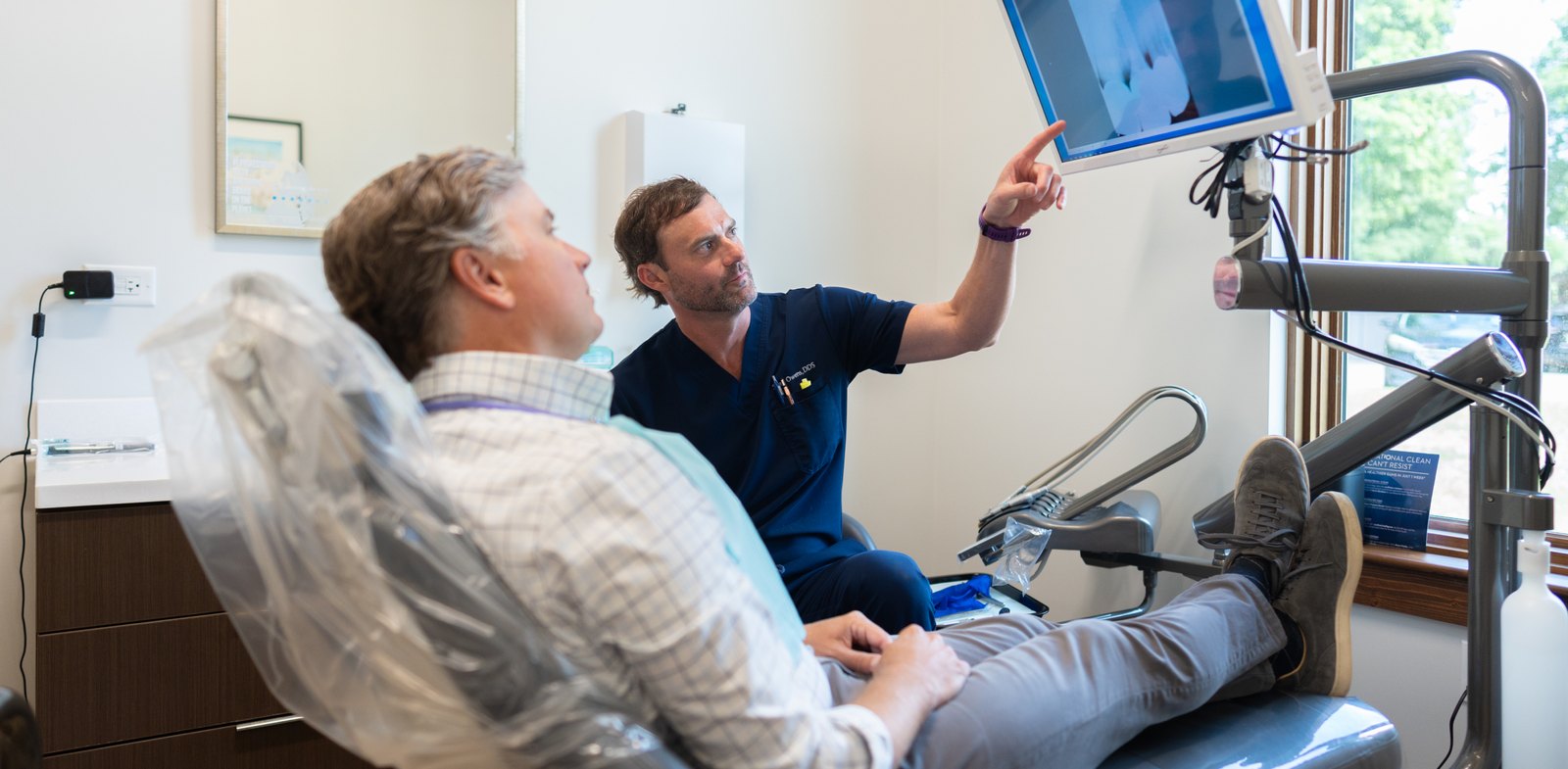
The visit that determines everything is the first one. Our doctors evaluate the site with digital X-rays and 3D scanning to see how much bone height and width you have, where the nerve and sinus sit, and how the opposing tooth bites. Dr. Sean Owens focuses on implant placement and surgical care, and the plan comes out of that record rather than a template.
Two findings change the plan more than any other: insufficient bone volume, which may call for bone grafting first, and active gum disease, which has to be brought under control because implants live in the same bone that periodontal infection destroys.
Stage 2: Placement
Placement is a smaller procedure than most patients expect. The site is numbed, the implant is positioned in the prepared channel, and the gum is closed around it. Sedation is available if you want it, including IV sedation for anxiety or longer combined appointments. Most people describe the following days as pressure and soreness rather than pain, and manage with over-the-counter medication.
Stage 3: Osseointegration, the Waiting Part
Over the next few months the bone grows onto the implant surface in a process called osseointegration, which is what makes an implant behave like a root instead of a peg. Nothing visible happens during this phase, and nothing should be rushed in it. If a tooth is missing in a visible spot, a temporary is made so you are not walking around with a gap.
Stage 4: The Final Crown
Once integration is confirmed, the abutment is attached and a digital scan is taken for the crown. The crown is shaped and shade-matched to your neighboring teeth, then seated and checked in your bite. From that appointment onward you brush and floss it like any other tooth.
How Long Does the Whole Thing Take?
Plan on several months from placement to final crown in a straightforward case, with most of that time spent healing rather than in the chair. Grafting adds months, because grafted bone has to mature before it can hold an implant.
Actual chair time is short: one surgical appointment, one restorative appointment, and brief checks in between. It is a long treatment made of short visits, which is very different from a difficult treatment.
Implant, Bridge or Nothing: How Do They Compare?
The most expensive option over twenty years is usually the one that looked cheapest at the start, because a gap left alone changes the teeth around it.
| Single tooth implant | Traditional bridge | Leave the gap | |
|---|---|---|---|
| Neighboring teeth | Untouched | Both are reduced to carry the bridge | Can drift and tip into the space |
| Bone at the site | Load is transmitted, so bone is maintained | No stimulus under the gap | Ridge narrows over time |
| Cleaning | Brush and floss like a normal tooth | Requires cleaning under the span | Simple, but the bite changes |
| Typical timeline | Months, mostly healing | Weeks | None |
| What can go wrong | Infection or bone loss around the implant if neglected | Decay in a support tooth ends the whole bridge | Bite collapse, opposing tooth over-erupts |
Leaving a gap is a real choice and sometimes a reasonable one for a back tooth with no opposing contact. But the drifting, tipping and bone loss that follow are the reason our doctors bring it up rather than letting it pass unremarked.
Am I a Candidate for a Single Tooth Implant?
Most healthy adults are. What matters is bone volume at the site, healthy gums, and general health that supports healing. Uncontrolled diabetes and smoking both raise the risk of failure, and heavy grinding needs to be managed with a nightguard so the crown is not fighting overnight forces.
Age is not the barrier people expect. Adults in their seventies and eighties receive implants routinely; what rules people out is the condition of the bone and gums, not the birth year. If bone volume is short, grafting often makes the site usable, and that is exactly what the imaging at the consult is for.
How Long Do Implants Last, and What Does Upkeep Look Like?
Our implants page states the practice’s position plainly: with proper care, implants can last a lifetime. What “proper care” means is unglamorous and non-negotiable, because the failure mode is biological rather than mechanical.
Brush and floss the implant crown daily, including the gumline where the crown meets tissue. Keep your cleanings and exams, so the bone level around the implant is checked and inflammation is caught while it is still gum-deep. Wear a nightguard if you grind. Implants do not get cavities, but the tissue and bone around them can get infected, and that is what ends an implant’s life.
What Can Go Wrong, and How Is It Prevented?
Implant dentistry has a high success rate, which is not the same as no risk. Knowing the three real failure modes explains what the appointments and the home care are actually for.
Failure to Integrate
Occasionally bone does not attach to the implant, usually because of poor bone quality, movement during healing, or smoking. It shows up early, within the first months, and the remedy is removal, a healing period, sometimes grafting, and a second attempt, which frequently succeeds.
Peri-implantitis, the Gum-and-Bone Problem
This is inflammation around a working implant that progresses into bone loss, driven by plaque and made worse by smoking and uncontrolled diabetes. It is the leading long-term threat to implants and is largely preventable with daily cleaning at the crown margin plus professional monitoring. An implant cannot decay, so nothing hurts until bone is already involved, which is exactly why scheduled checks matter.
Mechanical Issues
Screws can loosen and crowns can chip, particularly under grinding forces. Both are usually straightforward to service when they are reported early, and a nightguard removes most of the load that causes them.
Why the Crown on an Implant Is Its Own Decision
The crown is not an afterthought. It determines how force reaches the implant, how food is deflected away from the gum, and how the tooth looks beside its neighbors, which matters most on a front tooth where the gum outline shows.
Two details do most of that work. The contour where the crown meets tissue decides whether you can actually clean the margin at home, and an over-contoured crown traps plaque in the precise spot where peri-implantitis begins. And the bite is adjusted so the implant crown is not taking heavier contact than the natural teeth around it, because an implant has no ligament to cushion force the way a root does. That is why the final appointment includes bite checks rather than just cementing and waving goodbye.
Frequently Asked Questions About Single Tooth Implants
Does getting an implant hurt?
The placement itself is done under local anesthetic and typically feels like pressure. Afterward, expect soreness for a few days that most patients handle with over-the-counter pain relief. Sedation options are available if anxiety, not pain, is the real concern.
Can I get the implant and crown on the same day?
Sometimes, and only when the imaging and bone quality support immediate loading. It is a clinical decision rather than a preference: the implant has to be stable enough at placement to carry a temporary tooth while bone grows onto it. Where several teeth in a row are missing, the same principle underlies implant-supported dentures.
What if I have been missing the tooth for years?
Still worth evaluating. The site will have lost some bone width and height, so grafting is more likely, but long-standing gaps are restored regularly. Imaging will tell you in one visit what your specific site needs.
Will insurance cover an implant?
Coverage varies widely by plan, and many policies treat the surgical and restorative portions differently. Our team reviews your benefits and provides a written estimate before treatment begins, so the plan and the number arrive together.
Find Out What Your Site Actually Needs
One consultation with 3D imaging answers the questions that guessing cannot: how much bone you have, whether grafting is needed, and how long your case will take. Dr. Sean Owens and the team at Kidder Owens Dental place and restore implants in-house, which keeps the plan in one set of hands.
Call (225) 761-8585 or request an appointment at 9420 Perkins Rd, Baton Rouge. We see patients from Baton Rouge, Prairieville, Denham Springs, Gonzales, Central and Zachary.