
Invisalign straightens crooked teeth by moving them into a new position, keeping your enamel. Veneers cover the front of teeth to change how they look without moving them. For crowding or bite problems, aligners treat the cause; veneers suit mild unevenness plus chips or stains.
Both can give you a straighter-looking smile, so it is easy to see them as interchangeable. They are not. One changes where your teeth sit, the other changes what they look like on the surface. Knowing that difference makes the choice much clearer.
How Does Invisalign Straighten Teeth?
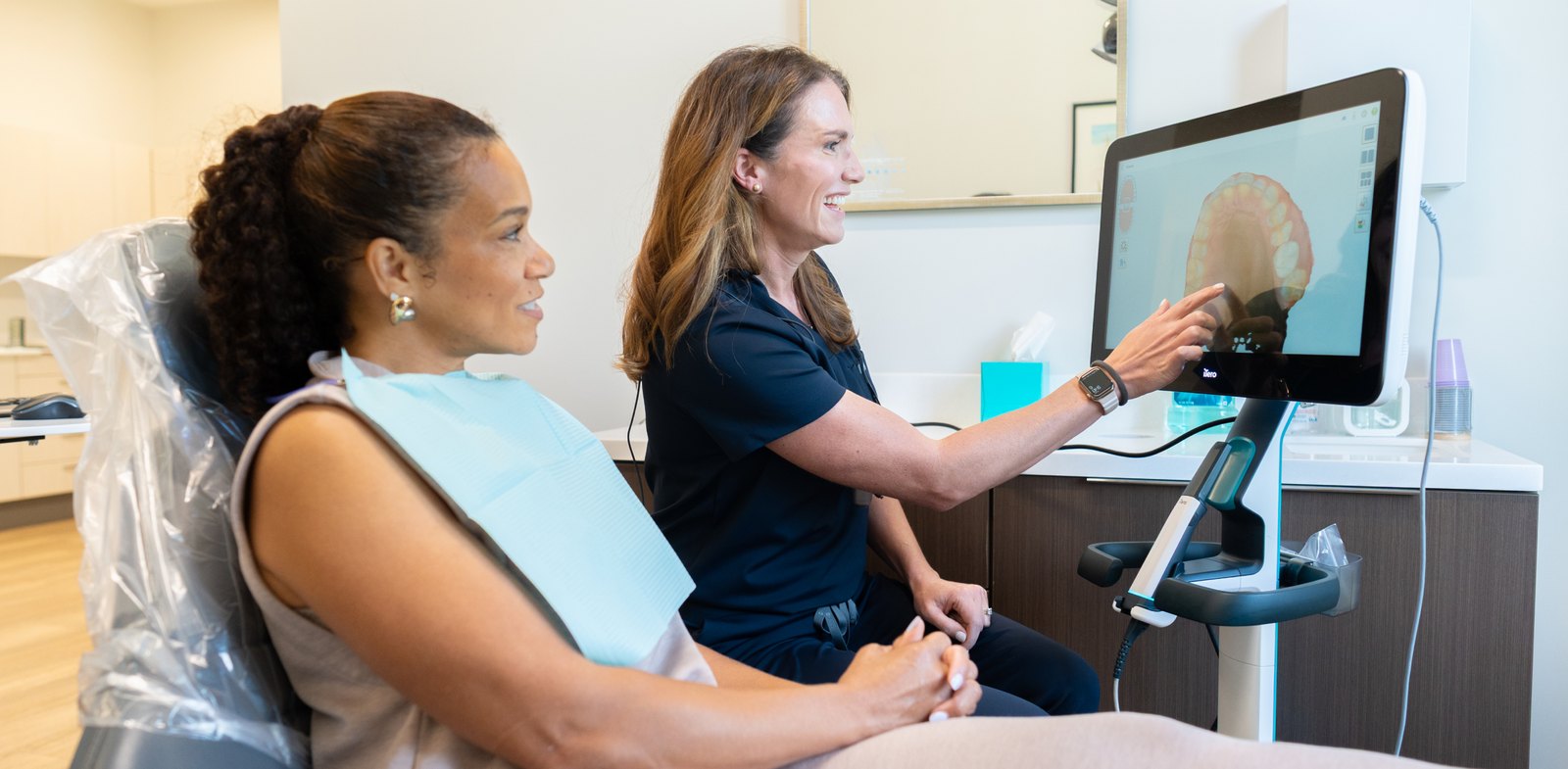
Invisalign uses a series of custom clear aligners that move teeth a little at a time. At Kidder Owens Dental, treatment begins with digital scans and X-rays, a conversation about your goals and a 3D preview of the expected result. You wear each set of aligners for 20 to 22 hours a day, switch to a new set every one to two weeks and come in for progress checks every six to eight weeks.
When treatment is complete, you receive a custom retainer to hold your teeth in their new position. Because the aligners come out to eat, brush and floss, cleaning your teeth stays simple throughout.
How Do Veneers Change a Smile?
Porcelain veneers are thin, custom shells of tooth-colored porcelain bonded to the front of the teeth. The practice uses them for stained teeth that do not respond to whitening, chipped or worn teeth, gaps, teeth that are irregular in shape or size, and teeth that are mildly misaligned or slightly crooked.
To make room for the porcelain, a small amount of enamel is removed from each tooth. The practice is clear that this step cannot be reversed: a prepared tooth will always need a veneer or another restoration covering it. Temporary veneers let you try the new look before the final porcelain is bonded.
Which Problems Does Each One Actually Fix?
The deciding question is whether your concern is about position or appearance. Invisalign is designed for crowded teeth, gaps, overbites, underbites, crossbites and rotated teeth. Veneers cannot change your bite or move a tooth that sits too far forward or back; they can only make teeth look more even from the front.
The practice’s own guidance reflects this. Its veneers page notes that larger gaps or crowding may be better handled with Invisalign first, while veneers can close small to moderate gaps and even out spacing. If your teeth are straight but chipped, dark or oddly shaped, aligners will not change that.
How Do Invisalign and Veneers Compare Side by Side?
This table draws on what Kidder Owens Dental publishes about each treatment.
| Invisalign | Porcelain veneers | |
|---|---|---|
| What it changes | Position of the teeth and bite | Color, shape and surface appearance |
| Effect on enamel | None removed | A thin layer removed; not reversible |
| Typical timeline | 6 to 9 months for mild cases, 12 to 18 for moderate, up to 24 for severe | A few visits |
| Daily commitment | Aligners worn 20 to 22 hours a day | Normal brushing and flossing |
| After treatment | Custom retainer to hold results | Veneers can last 10 to 15 years before replacement |
| Fixes bite problems | Yes, mild to moderate | No |
| Fixes stains or chips | No | Yes |
Why Does Keeping Your Enamel Matter?
Enamel does not grow back. Once teeth are shaped for veneers, they are committed to restorations for life, and veneers themselves will eventually need replacing. That is not a reason to avoid veneers, but it is a reason to use them for the right job.
When crooked teeth are healthy and the only goal is alignment, moving them with aligners keeps every bit of natural tooth structure. If you later decide you also want to change their color or shape, straight teeth give your dentist a better starting point, often with less preparation.
When Does Combining Both Make Sense?
Many smiles have more than one issue. A common plan is to straighten first with Invisalign, then add veneers to a few teeth that are chipped, worn or discolored. The practice notes that cases including whitening, Invisalign or gum contouring before veneers take longer, and that the timeline is mapped out at the consultation.
Whitening should come before veneers if you want your natural teeth brighter, because porcelain does not whiten afterward. When several treatments are coordinated like this, it becomes a smile makeover planned around your goals.
Sometimes neither is needed. The practice notes that one small chip or gap can often be fixed with dental bonding without preparing the tooth at all, so it is worth asking whether a smaller repair would solve the concern before committing to a full treatment.
Who Is a Good Candidate for Each?
Invisalign suits patients with mild to moderate misalignment who are willing to wear aligners most of the day. Veneers need a healthy foundation: healthy gums, enough sound enamel to bond to and a stable bite. The practice treats decay or gum disease before placing veneers, and if you clench or grind, it plans a custom nightguard alongside them to protect the porcelain.
If you are weighing veneers in particular, our article on whether you are a candidate for porcelain veneers covers the checklist in more depth. For aligners, see how long Invisalign takes for adults.
What Is Daily Life Like With Each Option?
With Invisalign, the aligners become part of your routine for several months. You take them out to eat and drink anything other than water, brush before wearing them again, and keep track of when to switch to the next set. The practice notes that some people feel minor pressure when they start a new aligner, which it describes as much less uncomfortable than traditional braces.
Veneers ask for less day to day once they are bonded. You brush and floss as usual, but porcelain can chip under force, so the practice advises against biting ice, pens or fingernails and recommends a nightguard if you grind. Teeth may feel slightly different for a short time after bonding while you get used to the new surfaces, and a follow-up visit lets the team check your bite and gums.
How Do the Long-Term Commitments Differ?
Invisalign has a clear finish line, followed by a retainer that keeps teeth from drifting back. Wearing that retainer as directed is what protects the result. Teeth that were moved are still natural teeth, so routine cleanings every six months keep them healthy.
Veneers have no finish line in the same way. The practice states they can last 10 to 15 years with proper care, which means planning for replacement at some point. Porcelain resists coffee, wine and tobacco stains, but the natural teeth around it can still darken, which is another reason to whiten before veneers rather than after. Either way, the investment lasts longest when the teeth and gums underneath stay healthy.
Frequently Asked Questions
Are veneers faster than Invisalign?
Yes. Veneers are usually finished in a few visits, while Invisalign takes months. Speed comes with the trade-off of removing enamel and not correcting the bite.
Can veneers fix crowded teeth?
Only mild unevenness. The practice notes that larger gaps or crowding may be better treated with Invisalign first.
Will I need a retainer after Invisalign?
Yes. A custom retainer is provided at the end of treatment to keep your teeth in their new position.
Does insurance cover either treatment?
Veneers placed for cosmetic reasons are often treated as elective by insurance. The practice accepts most major plans, offers in-house membership plans and financing through Cherry, and its team can review your benefits.
Plan the Right Treatment for Your Smile
The doctors at Kidder Owens Dental, including Dr. Elizabeth Kidder, whose focus includes cosmetic care and Invisalign, can show you what each option would look like. Request an appointment or call (225) 761-8585 to talk through your goals.